
What are solar panels and how do they work

How does a Solar System Work
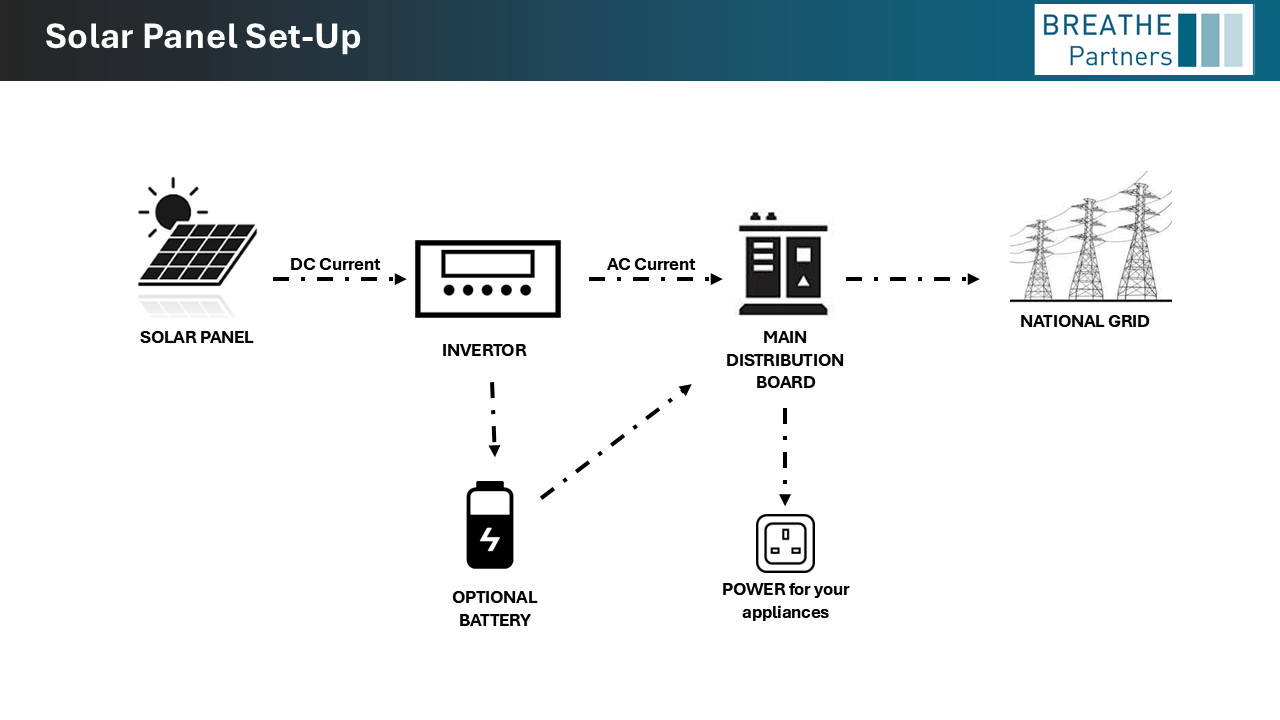
A solar system is made up of some key components which link to the main electrical set up
Photovoltaic Cells -> PV Cell or the Solar Panels
Invertor -> converting the DC collecting from the sunlight into AC which appliances can use
Optional Battery
These then link into the main electrical set-up of your building
How do the panels work?
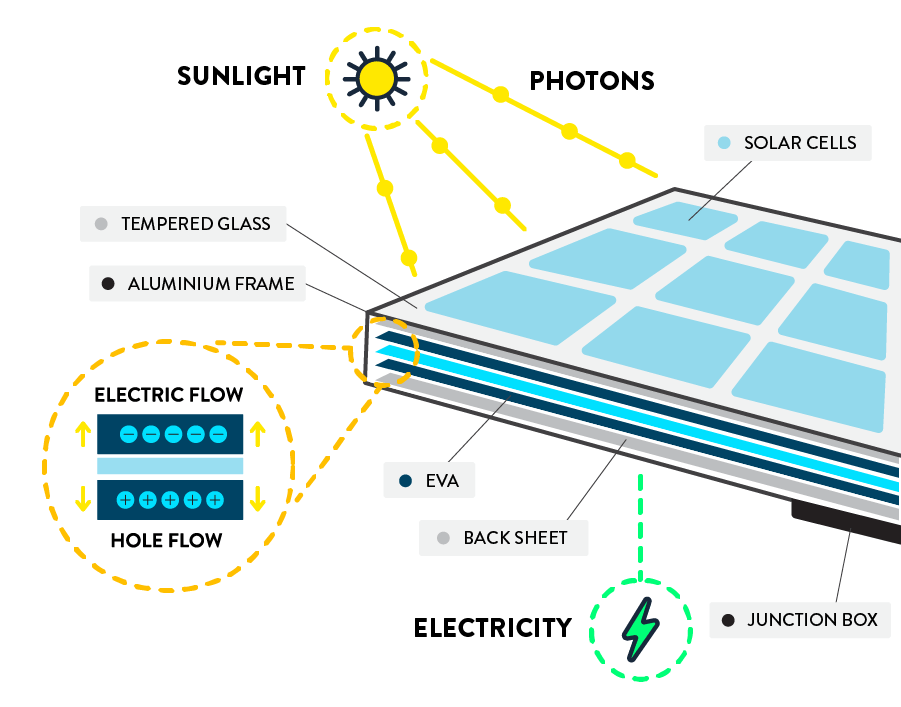
Solar panels utilise the photovoltaic effect, where when light knocks electrons loose inside a semiconductor (the photovoltaic cell) and an internal electric field guides them so they flow as an electric current
A photovoltaic cell is chosen to harvest photons from sunlight and uses this photovoltaic effect to convert solar power into direct current electricity. They are a non-mechanical device made out of semi-conductor material like crystalline silicon materials. There is a lot of research developing new and more semi-conductor materials (see later)
Some materials (like silicon in solar panels) normally hold their electrons in place, so they do not conduct much electricity.
When light (made of particles called photons) hits these materials, it gives some electrons enough energy to break free and move.
Inside a solar cell there is a built‑in electric field (from the p‑n junction) that pushes these freed electrons in one direction, creating a voltage and a flow of electric current.
Main types of solar panels (2025)
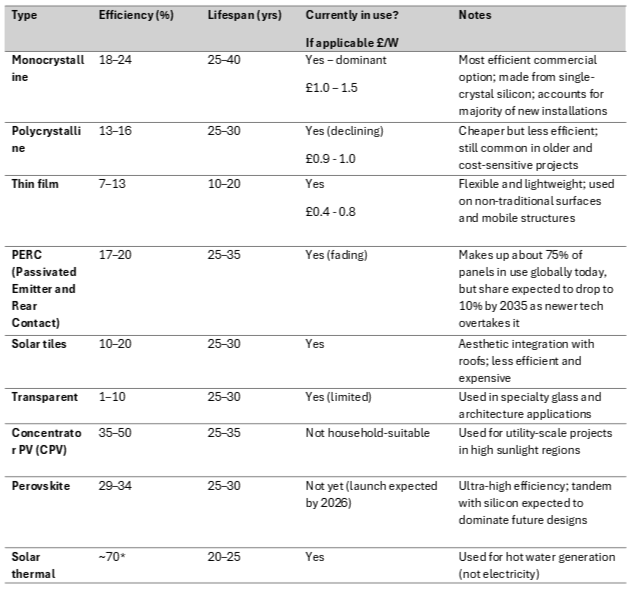
Solar panels come in several distinct types based on their material, structure, and use case. As of late 2025, the global market continues to be dominated by crystalline silicon technologies, but new generations such as perovskite and quantum dot cells are progressing rapidly toward commercialisation.
Global technology usage distribution (2025)
According to industry analyses, the global market remains about 95% crystalline silicon, divided roughly as follows:
· Monocrystalline silicon: ~70–75% of the market
· Polycrystalline silicon: ~15–20% (declining)
· Thin film technologies (CdTe, CIGS, amorphous Si): ~5–8%
· Emerging tech (perovskite, bifacial hybrids, CPV): <1% in active deployment
These figures align with projections from SolarPower Europe’s Global Market Outlook 2025–2029 and ITRPV data.
New and emerging solar technologies
Several innovations are gaining momentum and are poised to reshape the market:
Perovskite-silicon tandem cells – Combine perovskite (absorbs blue light) with silicon (absorbs red light), achieving lab efficiencies up to 33.7%. Commercial rollout is expected 2026–2027, led by companies such as Oxford PV in the UK.
Heterojunction (HJT) and TOPCon panels – Successors to PERC with enhanced rear contact and temperature resilience. Expected to replace PERC as the standard by 2030.
Quantum dot solar panels – Use semiconductor “dots” to extract multiple electrons per photon, theoretically raising efficiency toward 66%. Currently experimental and several years from commercial maturity.
“Zombie” solar cells – Thin-film designs with adaptive efficiency for indoor or low-light conditions, reaching up to 34% conversion efficiency in early lab tests.
Textured and bifacial cells – Dual-side collection and micro-structuring increase sunlight capture; bifacial panels now account for 15–20% of large-scale installations due to enhanced yield.
Summary
Monocrystalline panels remain the dominant and most practical option in 2025 due to their mature efficiency, reliability, and falling costs. Polycrystalline and thin-film are increasingly niche. The next major leap will come from perovskite-silicon tandem and HJT/TOPCon technologies, which could push mainstream efficiency above 30% and reduce solar power’s levelized cost of energy (LCOE) further in the late 2020s.