
The Commercial Solar Opportunity
The Rooftop Solar Potential for FMCG and UK Industry
Across the UK’s 5.6 million commercial buildings lies an untapped 2.5 billion m² of roof space, representing a once‑in‑a‑generation opportunity to reshape the cost base and sustainability profile of British industry. If just 40% of this space were equipped with rooftop solar, the commercial sector could host around 200 GWp of capacity, generating 190 TWh annually — equivalent to about 65% of current UK power demand.
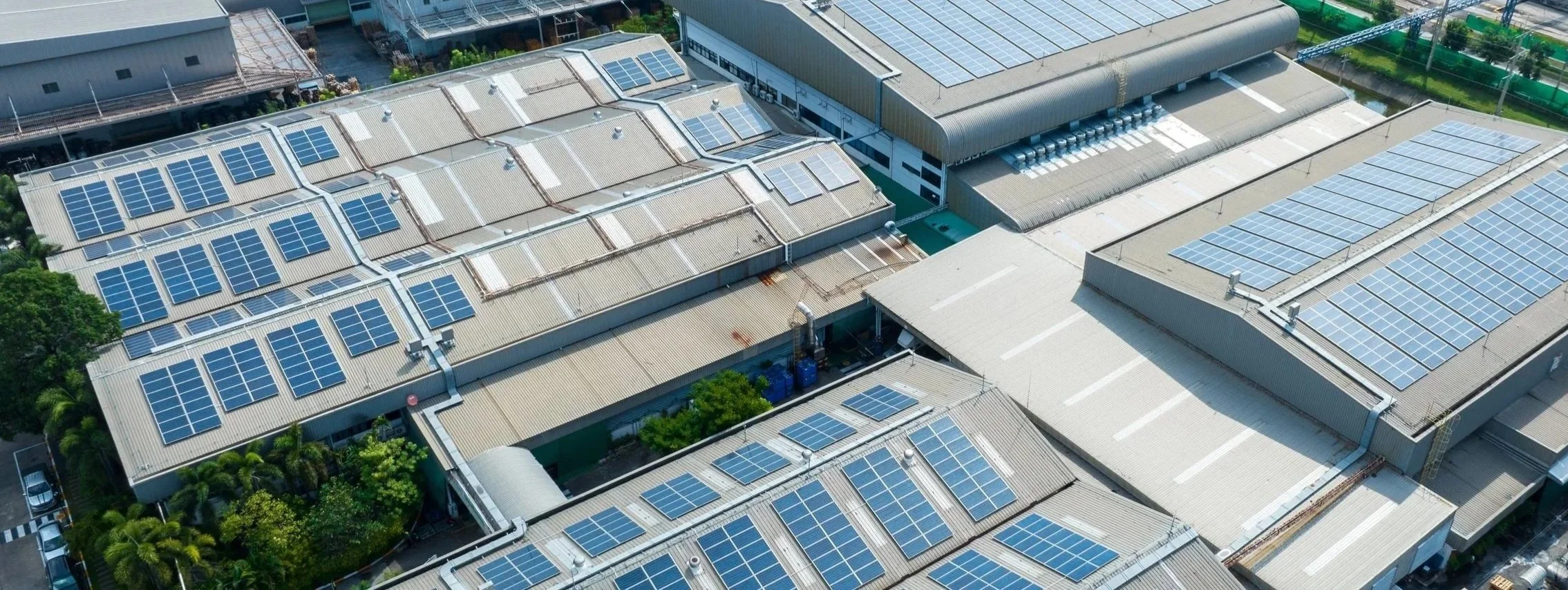
At a typical installed cost of £1,100 per kWp, this equates to around £220 billion in investment, generating stable onsite energy and paybacks between four and six years. For FMCG producers and logistics operators, a 10,000 m² warehouse can save around £190,000 per year, directly improving EBITDA while insulating operations from price volatility. Nationally, commercial rooftop systems could reduce collective electricity costs by up to £47 billion per year, strengthening energy security and competitiveness.
Rooftop generation provides energy exactly where it is consumed, avoiding 6–8% network losses, alleviating grid congestion, and reinforcing operational resilience. When coupled with battery storage and EV fleet charging, rooftop systems become central to fleet decarbonisation and process electrification — both critical to industrial net‑zero roadmaps. Full rollout could avoid over 100 Mt CO₂e by 2035, equivalent to removing 20 million petrol cars from UK roads.
Unlike grid-scale solar farms, rooftop solar produces power exactly where it’s used, cutting transmission losses by 6–8%, easing strain on regional networks, and improving power resilience. When paired with workplace EV charging and onsite battery storage, solar directly supports fleet electrification and process decarbonization — central goals for sustainability leadership. Collectively, full deployment could avoid more than 100 Mt CO₂e by 2035, equivalent to removing 20 million petrol cars from UK roads.
Addressing Implementation Barriers

Despite its strong economics, several practical and policy barriers limit adoption:
Grid connection and capacity constraints can delay or add cost to projects, especially above 1 MWp.
Older or structurally complex buildings often need roof upgrades before installation.
Planning restrictions, particularly for heritage or visually sensitive sites, can cause regional slowdowns.
Financing challenges persist for SMEs that lack upfront capital despite strong returns — an area suited to third-party funding and leasing models.
Split incentives in leased properties, where landlords control the roof but tenants pay for electricity, often suppress uptake. Structured energy sharing or cost-benefit allocation models can help bridge this gap.
Enabling Requirements: Market context and policy alignment
With targeted reforms, the commercial rooftop solar market could accelerate quickly, delivering vast cost savings and emissions reductions.
The UK Solar Roadmap 2025, released under the Clean Power Action Plan, sets an ambition to triple installed solar capacity to 45–47 GW by 2030 — up from ~18 GW now — with further expansion to 70 GW by 2035. The roadmap outlines over 70 policy actions to accelerate planning, unlock grid connections, and strengthen supply chains. Notably, it prioritises commercial rooftops, recognising them as the fastest, most cost‑effective route to clean power at scale.
Government reforms have created strong financial enablers for businesses to act. The 12‑year business rates exemption for rooftop solar, valid until 2035, and accelerated capital allowances both enhance ROI for corporate solar portfolios. Combined with low‑cost green finance frameworks through public‑private partnerships, the investment case is robust — high internal rates of return with long‑term tax stability
Policy measures such as:
· A presumption in favour of rooftop solar within planning frameworks
· Streamlined grid connection processes prioritizing behind‑the‑meter systems
· Private wire sharing across business parks and industrial estates
· Supportive financial instruments (green leasing, aggregated PPAs, tax‑aligned capital allowances)
would unlock large‑scale adoption across industry.
The Food and Drink Federation’s Net Zero 2040 roadmap and the broader FMCG sector’s decarbonisation commitments require deep reductions in onsite Scope 1 and 2 emissions. Rooftop solar not only reduces emissions but tangibly contributes to measurable ESG scores and investor disclosures under SFDR and TCFD. For retailers and manufacturers, solar energy underpins low‑carbon brands, investor confidence, and scope‑linked competitive advantage
In summary
Despite the strong economics, key barriers persist but if achieved, commercial rooftop solar capacity could rise from 19 GW today to over 200 GW by 2035 — generating 190 TWh annually while driving significant energy cost resilience for FMCG businesses and measurable carbon impact for sustainability teams.
Integrated Energy & Solar Solutions.
In the Transitions to a Net Zero World, Your Electricity Could Be Your Competitive Advantage
What’s Your Electricity Strategy & Plan?
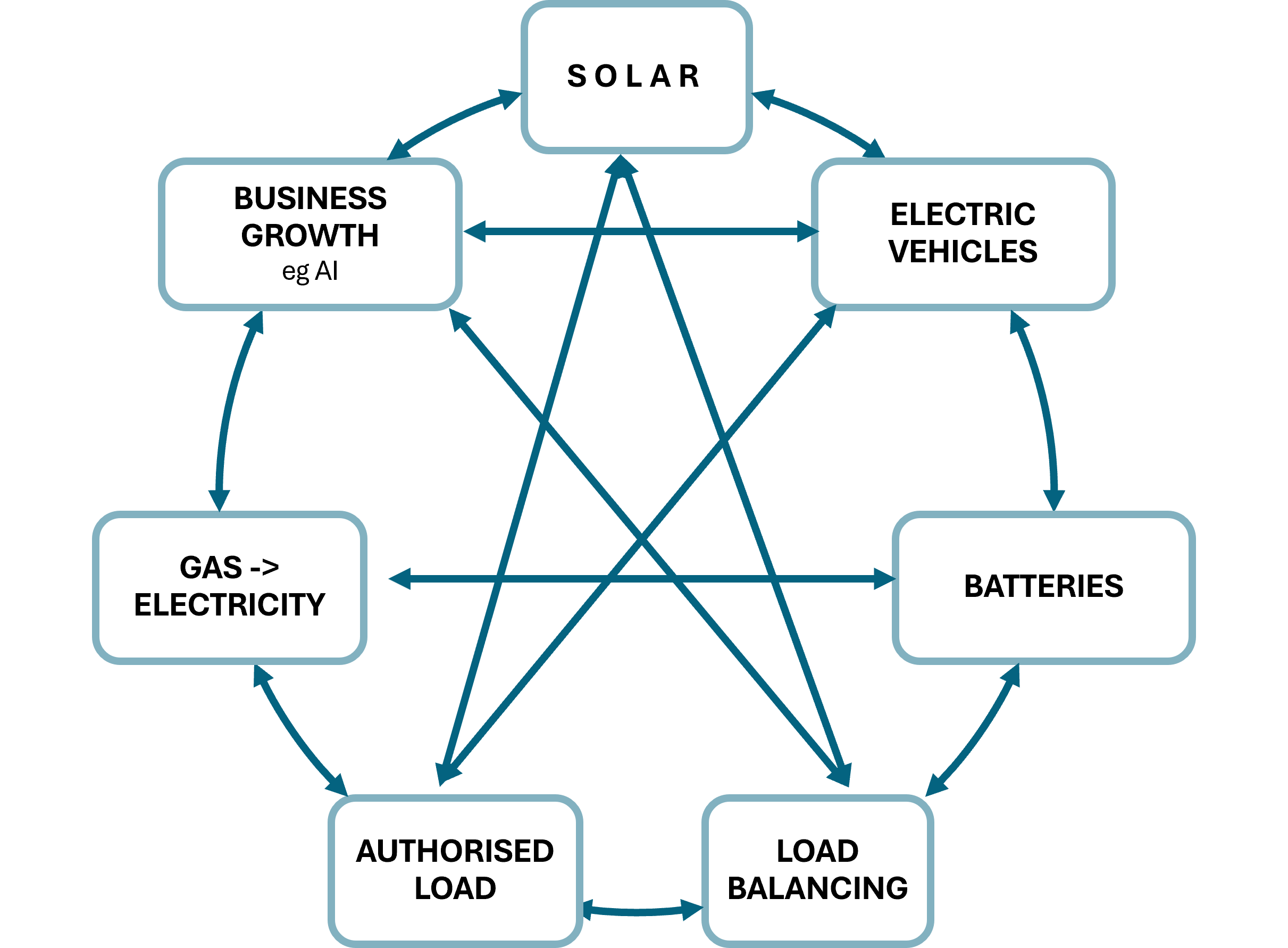
How much energy do I use now?
How much electricity will I need in the future?
Who will be competing for this extra electricity?
How do I minimise electricity costs?
Can I be more energy-efficient?
How do I prioritise my core systems?
Our Services
-
Commercial Solar
Do you have a strategy and plan for your estate to install Solar. Paybacks are typically 3 to 7 years followed by 25 years of free electricity. It increases you available electricity supply and helps future proof your site.

-
Load Balancing & Batteries
We can analysis power usage on site and flag opportunities using batteries, load balancing and other solutions to improve the electricity costs and increase the electrical robustness and futureproofing of the site

-
Integrated Power Strategy
We help you create an integrated power strategy for Net Zero, aligned with your business objective. We consider everything e.g. Solar, EV charging, load profiles, gas usage etc. Then we help you deliver it, simple!
